Raising Cane’s Mascot Cane the Dog Story
Raising Cane’s mascot Cane the dog is one of the most recognizable parts of the brand’s identity. If you have ever wondered why a chicken finger chain is so connected to a yellow Labrador Retriever, the answer goes back to founder Todd Graves and his original dog, Raising Cane.
According to Raising Cane’s official brand story, the restaurant was named after Todd Graves’ yellow Lab, who was often with him during the early days of building the business. Since then, Cane the dog has become much more than a name. The mascot now represents the brand’s personality, history, and community presence across Raising Cane’s restaurants.
Who is Raising Cane’s mascot Cane the dog?
Raising Cane’s mascot Cane the dog is a yellow Labrador Retriever that serves as the brand’s namesake and mascot. The dog is not a random marketing symbol. Instead, the entire restaurant chain took its name from Todd Graves’ original yellow Lab, Raising Cane.
That origin story makes Cane different from many fast-food mascots. Some brands invent a cartoon or character long after the business becomes popular. Raising Cane’s built its identity around a real dog from the start.
Today, when people talk about Cane the dog, they may mean the original dog or one of the later mascot dogs that continued the tradition. Raising Cane’s official “Why the Dog?” page explains that the company has carried on a Labrador legacy through Cane I, Cane II, and Cane III.
Why did Raising Cane’s use a dog as its mascot?
The answer is simple. The dog came first.
When Todd Graves was deciding what to call the restaurant in 1996, he originally considered naming it “Sockeye’s” after salmon he fished in Alaska. According to Raising Cane’s official story, a friend suggested naming the restaurant after his yellow Labrador Retriever instead. That dog was often at the construction site while the first restaurant was coming together.
That suggestion stuck, and it shaped the brand forever.
So the dog mascot is not just a fun logo choice. It is directly tied to the company’s name and origin. That gives the mascot more meaning than a typical restaurant character.
Why this brand story matters
Customers often remember brands more easily when there is a human story behind them. In Raising Cane’s case, the story is personal, simple, and easy to repeat.
It also fits the brand’s tone. Raising Cane’s tries to feel friendly, local, and full of personality even as it has grown into a large chain. A yellow Lab mascot helps reinforce that feeling.
The Labrador legacy: Cane I, Cane II, and Cane III
Raising Cane’s officially recognizes three mascot dogs in its history. Each one has helped carry the Cane name forward.
| Cane dog | Official role in the brand story |
|---|---|
| Cane I | The original Raising Cane and the company’s namesake |
| Cane II | A beloved mascot and certified pet therapy dog |
| Cane III | The current mascot carrying on the tradition |
This is one of the more distinctive parts of the Raising Cane’s mascot story. The chain did not stop with one dog from the past. It turned the mascot into an ongoing tradition.
Cane I: the original namesake
Cane I lived from 1992 to 1998 and was the original Raising Cane. According to the company, he was a friendly yellow Lab who loved being around people and would even wear Todd Graves’ sunglasses.
He was the dog that inspired the restaurant name. That alone makes Cane I a permanent part of Raising Cane’s identity. The company also says his picture can be found outside most Raising Cane’s restaurants.
For customers, this explains why Cane feels baked into the brand rather than added later for decoration.
Cane II: the therapy dog mascot
Cane II served as mascot from 1999 to 2016 and had a special place in the company’s story. Raising Cane’s says she was a certified pet therapy dog who regularly visited hospital patients and provided therapeutic care at hospitals around the country.
That detail adds another layer to the mascot image. Cane II was not only part of the brand. She also represented community care in a direct way.
The company says Cane II was a fixture at its Restaurant Support Office and at community events for years. So for many longtime fans, Cane II helped define the public image of the brand during a major growth period.
Cane III: the current Raising Cane’s mascot
Cane III, born in 2017, is the current mascot. Raising Cane’s says she continues the legacy of Cane I and Cane II and loves visiting restaurants and getting belly rubs from crew members.
The company also features Cane III in store designs, news updates, and mascot-themed decor. For example, official restaurant opening stories mention Cane III statues and location-specific Cane artwork in places like Chicago, Washington, D.C., and Times Square.
That shows how the mascot now works on multiple levels. Cane III is a real dog in the brand story, but she is also a design element and a recognizable symbol across flagship locations.
Where customers see Cane the dog in Raising Cane’s restaurants
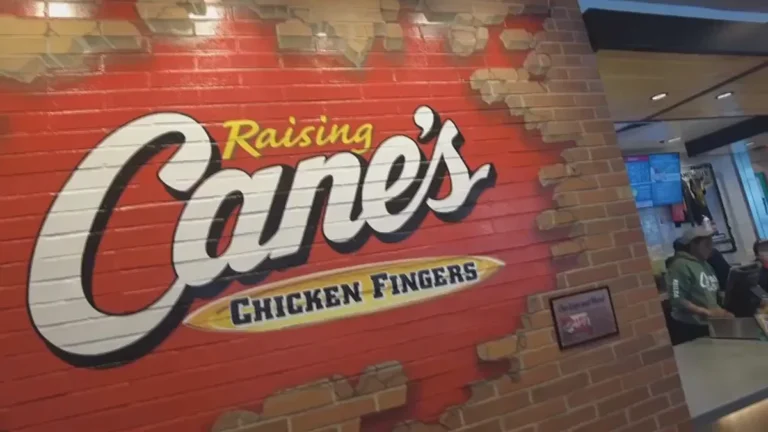
Even customers who never read the brand story often notice Cane inside Raising Cane’s restaurants. The dog appears in photos, statues, murals, and themed design touches.
In some locations, especially newer flagship restaurants, the company highlights Cane III as part of the visual identity. Official store opening pages mention:
- A three-foot Cane III statue in the Chicago flagship
- A Lady Liberty-themed Cane III statue in Times Square
- A colonial-themed Cane design in Washington, D.C.
- Cane-inspired artwork in special restaurant interiors
This matters because it shows the mascot is not hidden in a small logo detail. Instead, Cane is part of the customer experience.
Why the mascot works so well in-store
Raising Cane’s restaurants already have a distinct visual style. The brand leans into playful decor, murals, and local touches. A dog mascot fits that environment naturally.
It also helps the stores feel more personal. Even when a restaurant is in a huge city, the Cane story brings the brand back to its roots.
Is Cane the dog just a mascot, or part of the brand identity?
Cane is both.
At one level, Cane is clearly a mascot. The dog appears in branding, decor, events, and public-facing company storytelling. But at a deeper level, Cane is tied to the company’s name, founder story, and long-term personality.
That is why people searching for “Raising Cane’s mascot Cane the dog” are really asking more than one question. They want to know:
- Who the dog is
- Why the chain is named after a dog
- Whether Cane is a real dog
- Which Cane is current now
- Why the mascot matters so much to the company
The answer to all of those is connected. Cane the dog is part of how Raising Cane’s explains who it is.
How Cane the dog supports the Raising Cane’s brand
A mascot can help a restaurant stand out, but Cane does more than that. The dog supports several parts of the brand at once.
Brand recognition
A yellow Lab is easy to remember. That helps Raising Cane’s stand out in a crowded fast-food and chicken chain market.
Founder story
Because the mascot comes from Todd Graves’ real dog, it supports an authentic origin story. Customers often trust brand stories more when they feel personal and specific.
Community image
Cane II’s therapy work and Cane III’s presence at public events help the mascot feel warm and approachable, not purely commercial.
Store design and merchandise
Cane gives Raising Cane’s an easy visual anchor for artwork, statues, gifts, apparel, and location-specific themes.
This combination is one reason the mascot feels stronger than many restaurant mascots. Cane is not carrying the whole brand alone, but the dog fits nearly every part of it.
Do fans actually care about Cane the dog?
Yes, especially loyal customers.
Some people just want the chicken fingers, Cane’s Sauce, Texas toast, and combo meals. But regular fans often enjoy the personality of the brand too. For them, Cane adds charm and continuity.
That matters because Raising Cane’s menu is intentionally narrow. Since the food selection is simple, the company uses culture, service, and visual identity to deepen customer loyalty. Cane the dog helps with all three.
The mascot also gives the brand a softer, friendlier feel than a chain built only around product messaging. Instead of talking only about chicken fingers and combo meals, Raising Cane’s can tell a fuller story.
FAQs
Raising Cane’s mascot is a yellow Labrador Retriever named Cane. The mascot is based on the founder’s real dog and is part of the brand’s origin story.
The restaurant was named after Todd Graves’ yellow Lab, Raising Cane. According to the company, the dog was often with him while the first restaurant was being built.
Yes. The original Cane was a real yellow Labrador Retriever, and Raising Cane’s has continued the tradition with Cane I, Cane II, and Cane III.
Cane III is the current Raising Cane’s mascot. The company says she was born in 2017 and continues the Labrador legacy.
Customers can often see Cane in restaurant photos, decor, statues, and themed artwork. Some flagship stores feature large Cane III displays or location-specific mascot designs.
Conclusion
Raising Cane’s mascot Cane the dog is much more than a cute restaurant symbol. The dog is tied directly to the company’s name, its founder’s story, and the personality the brand has built over the years.
From Cane I to Cane III, the Labrador legacy has become a memorable part of Raising Cane’s identity. If you want to understand why the chain feels so distinct, Cane the dog is a big part of the answer. The mascot adds history, warmth, and recognition to a brand already known for its simple menu and loyal fan base. Check One Love Foundation Charity